I love it when a game defies my expectations sufficiently to make me
uncomfortable. If a game can make me feel discomfort, there's something
worth considering there--something that merits deeper understanding.
There are things that a game can say about the player that couldn't be
said in any other medium, and sometimes the message is all the more
effective when I'm caught vulnerably by my own assumptions.
My first experience with this kind of discomfort came during my first
playthrough of Mass Effect 2. Near the end of the game Shepard--the
protagonist and player character--has accumulated a band of compatriots
toward a final mission to stop the Reapers; but just before that final
mission, the ship's crew is abducted by the Collectors.
Mass Effect is a role-playing game, and understanding genre tropes is an
important aspect of interpreting a work and its impact. Many fantasy
role-playing games have a similar plot point: the hero has completed his
preparations. He is near the end of his journey. The stakes have never
been higher, and the situation is urgent: Meteor is about to crash into
Midgar; Ganon is about to destroy Hyrule; or, as is the case in Mass
Effect 2, the Reapers are preparing to consume all life in the galaxy.
But role-playing games have another trope: the side quest. These are
typically available throughout the game; but the moment before the final
climactic mission is the last chance in most RPGs to finish up any
side-quests that have been left undone. In Mass Effect 2, side quests
take the form of "loyalty missions"--character-specific missions that
provide additional backstory and interpersonal context for the members
of your cohort. Completing these missions also improves an invisible but
important loyalty stat which affects how team members respond to
Shepard.
I'm a bit of a completionist, so I took this opportunity before the
final mission to complete all of these loyalty missions. I did this all
while I poked fun at the video game tropes on display: the big bad,
poised and ready to attack; we, the player character, traipsing about
the galaxy on unrelated menial missions. After all: Meteor won't crash
into Midgar until the plot is ready for it; Ganon never will destroy
Hyrule; and the Collectors will wait around until Shepard is good and
ready to face them.
But that's not what happens. When I finally did embark on the final
mission to stop the Collectors and rescue the crew, we found only Dr.
Chakwas alive.
They're gone. All of them. I'm the only one left.
I watched them die. They were... processed--rendered down into some
kind of raw genetic paste and pumped through these tubes.
What took you so long, Shepard? You could have saved them if you'd
gotten here sooner!
Dr. Chakwas' words are true. While I was taking my time maximizing a
gamified loyalty stat, the game was monitoring my activities after the
abduction of the crew. Leave immediately, and you may save them all; but
the longer you wait, the more of them die.
With this, the game defies trope, and punishes the player for
approaching the work as a simple genre piece. In reality, Shepard would
never meander about, but would prioritize the mission and the retrieval
of the crew. But it's just a game, right?
But it is the fact that it is a game that enables this experience. A
character in a book won't die because you waited a week to read the last
chapter; but in my Mass Effect, we lost the entire crew: named
characters with backstories and interactions that had developed
throughout the game. And the consequences don't end there, either: Mass
Effect is a three-part series, and the death of these characters carries
on even into the next game.
Mass Effect 2 expects you to care about its characters; and, if you
don't--if you just play it like a video game, expecting it to behave
like other video games--it punishes you for it by taking those
characters away.
But even then, I never would have expected to feel this same defiance of
expectation from Epic Mickey.
Epic Mickey could hardly be more different from Mass Effect. It's a
third-person platforming character action game with light adventure
elements. It's a children's game, contrasted with media hysteria
regarding Mass Effect's "mature" content. More immediately, Mass Effect
is a good game; and I definitely wasn't enjoying Epic Mickey.
But I have kids, and those kids were excited about Mickey, so I was
playing through it as a social activity with them. I really wasn't
taking it seriously: jump on the platforms; paint the environment with
the magic paintbrush; mash "A" when characters talk to you; make
"progress."
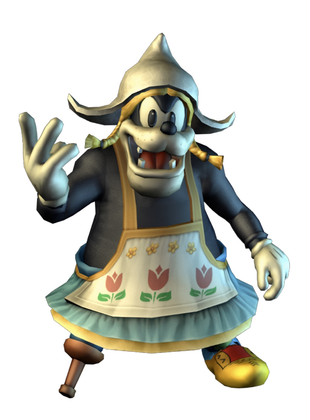
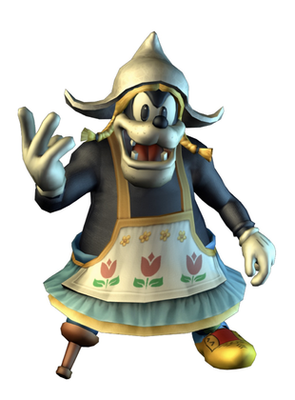
Not too far into the game, I ran into a character called "Small Pete," a
rendition of a classic Disney character, "Pete," who often serves as the
antagonist of a Mickey Mouse story.
I spent years getting' along with gremlins. Only had to knock 'em
around on occasion. Then, the ONE TIME I crash my boat into their
village, they seem to think I'm some kinda villain.
Not that I give two hoots what they think, but it WAS an accident.
And my ship's log will prove it.
Those little monsters won't let me near the wreck to get it, though.
Hmm... I'll bet they'd let you.
I was immediately suspicious of Small Pete's story (assuming I paid it
any mind at all, beyond just mashing "A"); but we got a quest objective
and moved on.
I continued jumping between platforms, tagging the environment, and
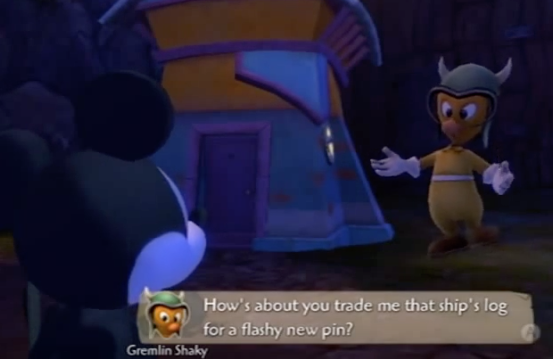
mashing "A," until we met Gremlin Shaky.
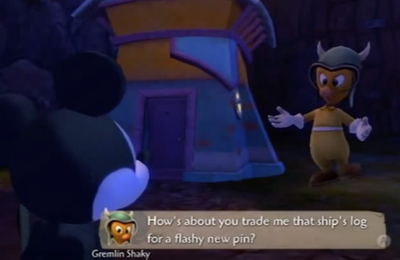
I smell treasure! You found it!
How's about you trade me that ship's log for a flashy new pin?
I still wasn't paying attention. Why would I? The platforming was
mediocre. The characters were either flat or carbon copies of each
other. Each gremlin looks the same as all the others. So I interpreted
this interaction with the same level of attention that I would pay to
most collect-a-thon games:
"Oh, right. The ship's log. I guess I picked it up along the way. Pete
wanted us to get that for him, right? What was that for, again? This
must be the guy I'm supposed to give it to. And when I do I'll get a pin
as a reward, eh? Ok, I guess it's a collectible, so I guess I'll do it."
Thank you very much. This will make excellent reading. Here's your
pin.
But that wasn't all there was to it. Immediately after finishing the
interaction I received a "quest failed" notification.

I kept playing, just accepting that I had failed the quest, and probably
missed out on some minimal benefit. But something about the interaction
bothered me. Small Pete seemed to be a character teetering on the edge
of villainy. He was willing to "knock 'em around on occasion"; but he
seemed genuinely (if covertly) concerned with clearing his name. He
wasn't a villain yet. He was a bully.
So you left my ship's log with those grubby gremlins, eh? Well,
here's a little taste of what happens to those who cross me!
I had betrayed Small Pete. I hadn't done it out of malice. Worse: I had
paid him no mind. He asked for help, and I ignored him. Eventually, I
traded his name for a collectible pin I didn't even care about. In a
literal sense, I had turned him into a villain: Small Pete had become a
video-game boss, generating a combat encounter to punctuate the chapter.
I found myself considering what it would take to correct this mistaken
path through the game's narrative. I had overwritten my save several
times since I had given Pete's ship's log to Gremlin Shaky. I would have
to start the game over from the beginning.
The very fact that I was considering it made me uncomfortable. I did not
enjoy playing this game. But, for the sake of a fictional character as
absurd as Small Pete, I was considering sacrificing some portion of my
time in pursuit of his redemption.
I tell my kids that it's part of a parent's job to give them
consequences that they can learn from and grow through, while protecting
them from consequences that they can't recover from, if only for a time.
In a small, but very real, way, Epic Mickey was that for me. I ignored a
call for help. I was careless. A character was treated unjustly, and
that injustice led him to embrace his own darker tendencies.
I never did go back and do right by Small Pete. In fact, I don't think I
played the game again after that. I'm sure we were called down for
dinner, and then distracted by another game I enjoyed playing more. But
I still think about Small Pete, about the time I didn't pay enough
attention, and about the consequences that might develop when I allow
myself to become just a little bit more callous to the world around me.